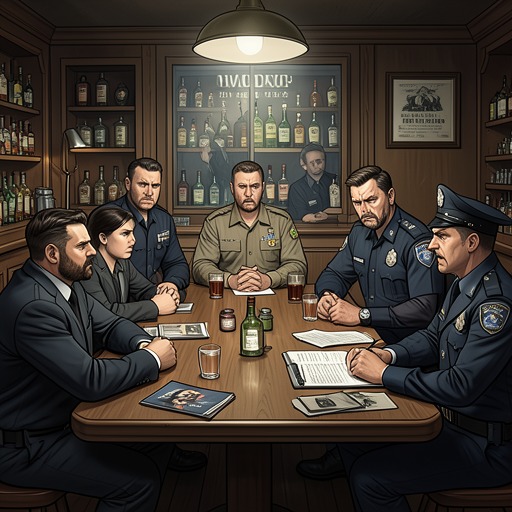
Sons of Wolves clubhouse
Stolen WanderThe Sons of Wolves clubhouse is the central institutional space of the Sons of Wolves Motorcycle Club, presenting brotherhood as both refuge and discipline. Rex Foster once found in the club the brothers he believed he needed, but the same clubhouse later becomes the setting in which his loyalty is tested, his fear for Nancy O’Neill overwhelms his allegiance, and his departure is formalized. Its rooms therefore hold two competing meanings: sanctuary for men bound by violence and a prison of identity for a member who begins to imagine another life.
Definition and Social Function
The clubhouse is attached to the club’s everyday routines and its hierarchy. It contains a bar, a dormitory wing, and a garage beside the main building, making it at once a residence, workplace, drinking venue, and meeting place. Rex’s statement that he joined the Sons of Wolves Motorcycle Club and found the only brothers he would ever need identifies the emotional bargain at its center: family is rejected in favor of chosen male loyalty, while the clubhouse supplies the physical setting in which that replacement family operates.
The space is also governed by informal observation and collective judgment. Snake’s jeers, the Old Man’s orders, the boss’s authority, and the presence of other members make personal conduct visible to the group. When Rex is punished, the clubhouse does not merely house the punishment; it turns the punishment into a communal performance. The club’s masculine code is enacted through mockery, endurance, threats, and the expectation that a member will accept consequences without appearing weak.
Punishment, Labor, and Drinking
After Rex’s conduct has displeased the club, the Old Man assigns him a deliberately filthy car in the garage and orders him to make it shine by the following morning. The vehicle is covered in muck, oil, and other waste, and Rex fills five buckets with water, each becoming brown and gummy while the car remains less than one-fifth clean. The task takes roughly an hour and a half, turning the garage into a site of forced labor and humiliation rather than ordinary mechanical work.
Rex eventually hoses the dirt from himself, changes clothes in the clubhouse’s dormitory wing, puts on his jacket, and sits at the bar to play poker and drink whisky. The sequence links punishment to the club’s routine pleasures: the same institution that disciplines his body offers alcohol, gambling, and male companionship as consolation. Yet the ritual no longer restores his sense of belonging. While he drinks, Nancy remains constantly in his thoughts, and the clubhouse becomes a place where the attractions of club life are measured against the emotional damage caused by abandoning her.
The clubhouse also reveals anxiety beneath its aggressive code. Rex asks whether a married man is afraid of hurting or corrupting his wife through the violence associated with the club. He gestures toward the clubhouse as the embodiment of that danger, suggesting that the building is not neutral background but a concentrated image of the club’s habits and moral atmosphere. His question exposes the fear that brotherhood founded on violence can deform intimate relationships and reproduce the same injuries it claims to protect its members from.
The Departure and Its Terms
Rex’s relationship with the clubhouse changes decisively when he tells the Old Man and the other members that he may no longer belong in that life. The Old Man warns that once Rex is unpatched, there will be no return. The boss allows him to leave but imposes strict conditions: Rex may no longer live in Salem, enter the clubhouse, or visit the club’s bars, and the club will not be responsible for anything that happens to him. Departure is therefore not a casual resignation. It is a severing of protection, territory, and institutional identity.
Rex accepts the possibility of exile because the clubhouse’s brotherhood has ceased to answer the question that matters most to him. He entered the life as a furious child, grateful that the club had admitted him, but now believes it is no longer the right place for him. The clubhouse thus marks the distance between his past and his emerging responsibility: it gave him belonging when he was defined by rage, yet it cannot accommodate his need to protect Nancy or become accountable for the consequences of his choices.
Armed Confrontation and Institutional Exposure
Before the departure can be completed, Michaels arrives at the clubhouse with thirteen men in civilian clothes who move like police officers. Their entrance transforms the club’s gathering place into a contested zone between bikers and law enforcement. Michaels threatens Rex, and Rex refuses to let Snake speak for him, emphasizing that he is no longer a Son of a Wolf and has surrendered his right to the club’s protection. The clubhouse’s rules therefore become immediately tangible: membership provides collective defense, while renunciation leaves a man exposed even when he is still physically among his former brothers.
The confrontation escalates when Michaels draws a small handgun. Every man in the room produces a gun and aims it at someone on the opposing side, creating a full standoff inside the clubhouse. Michaels presses the weapon against Rex’s forehead, and the room’s communal identity is revealed through the arrangement of weapons: the clubhouse is a brotherhood, but it is also an armed architecture in which belonging, authority, and survival are negotiated at gunpoint.
This scene also collapses the boundary between criminal and official power. Michaels and his men arrive with the bearing of police, while the bikers respond as an organized armed group. The boss addresses Michaels as an officer while barely containing his anger, and the supposedly protected clubhouse becomes the place where competing claims to law, masculinity, and legitimate force confront one another. Rex’s willingness to stand exposed after surrendering club protection makes the conflict a test of personal dignity as much as a physical threat.
Narrative Significance
The clubhouse’s importance lies in its double function. It is the material home of the only brotherhood Rex once trusted, but it also concentrates the drinking, violence, surveillance, and coercive loyalty from which he must separate himself. Its bar can offer companionship while keeping him trapped in whisky and memory; its garage can enforce discipline through degrading labor; its meeting space can promise protection while making that protection conditional on obedience.
Against the domestic spaces associated with Nancy O’Neill and her family, the clubhouse represents chosen allegiance without emotional safety. Rex’s later effort to help Bill O’Neill recover depends on a different model of manhood, one based on facing mistakes and fighting for a way back rather than repeating violence. The contrast gives the clubhouse its final resonance: it is not simply where Rex belonged, but the place that clarifies why belonging alone is insufficient. Leaving it costs him territory and protection, yet the loss makes possible his movement toward responsibility, intimacy, and redemption.